loon and flock

loon and flock
Showing posts with label cockatoo. Show all posts

Thursday, April 3, 2014

Birding near Wombeyan Caves

Matt and I took a camping trip to Wombeyan Caves in January, in the middle of the Aussie summer.

We drove down on a Friday after work as the sun set, leaving the last hour of the drive in darkness on a winding dirt road. I was behind the wheel, nervously bumping along in the night, trying to avoid any kangaroos and wombats that might be hopping or ambling along the road. We saw both, and fortunately made it to the camp site with a collision-free, albeit dusty, car.

Me in a cave. We were close to the top of the cave here, so you can see some natural light coming in.

Kangaroos lounging in the shade beside a ranger's house.

We spent the hot mid-days exploring the various caves and reserved early morning and evening for our excursions out of doors - bush walks, bird-watching, beer-drinking, swimming in the local watering hole, and lounging around like these guys.

Australian Magpie getting cocky as he tried to steal food from noisy miners.

Kookaburra - looks like a juvenile. This one didn't make any calls but we woke up to quite a racket one morning.

The feathered cast consisted of the usual suspects - magpies, noisy miners, kookaburras - as well as some standouts: a Gang Gang Cockatoo, Australian King Parrots, a pair of masked lapwings, a very tame satin bowerbird, and a few superb lyrebirds with their extraordinary plumes.

This female satin bowerbird made friends with us as we drank an afternoon beer.

This Gang Gang cockatoo was really old and fat - a campground local no doubt.

Top: A male Australian King Parrot plays in the trees with his mate. Bottom: 2 female king parrots look for good things to eat in the mud.
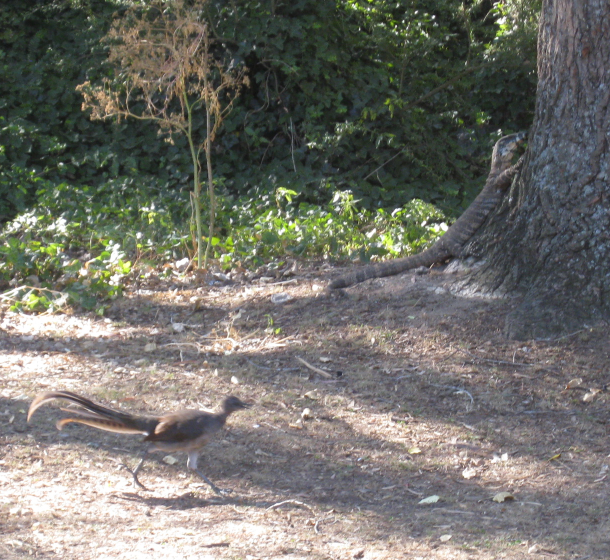
This superb lyrebird is dangerously close to a goanna - who was dangerously close to our tent! Don't worry, goannas aren't dangerous to humans... but they do have bad eyesight and will try to climb up you. They also won't eat an adult lyrebird - but they do steal lyrebird eggs.

Pair of masked lapwings - quite far from a water source.

All in all it was a very enjoyable trip, and Wombeyan Caves turned out to be a great spot for summer birding!


Friday, March 7, 2014

Trip to Blackheath

Last September, Matt and I took a trip to Blackheath in the Blue Mountains. Highlights included the amazing view from our balcony overlooking the Kanimbla Valley, high tea in the Megalong Valley, and, you guessed it, birdwatching near Govett's Leap lookout.

Bridal Veil Falls

The Crimson Rosellas were out, and this trip marked our first glimpse of these beautiful red and blue birds. We did a sunset hike to Bridal Veil Falls, where a small flock of Crimson Rosellas was quite active.

Crimson Rosella

Crimson Rosella

Crimson Rosella (Imm.)

It turns out they're fairly common in this area. They also make pretty sounds, which my bird guide describes as "bell-like whistles." Whatever that means. I still haven't been able to train my ear to identify birds by their calls. I'm quite musical, but I imagine it could take years of practice. Just when you think you have it down, some new forest bird makes a noise and you've forgotten it all again.


If you're planning a trip to Blackheath soon, you might check out the birdlist for the area on Eremaea. Their logo is, in fact, the Crimson Rosella. I've found that this site is a really good way to prepare for bird-watching before visiting a new area.

The list says that Rockwarblers, Glossy-black Cockatoos, and Superb Lyrebirds are also common between the Govett's Leap and Evans Lookouts. We went to both lookouts and didn't see much the day we were there, though we did spy some Sulfur-crested Cockatoos and a cute little lizard. Also prevalent were road signs warning us of the indigenous wildlife.

Cockatoo near Govetts Leap Lookout

Lizard at Evans Lookout


Tea in the Megalong Valley introduced us to the crafty little White-winged Choughs, who tried to steal our kidney pies when we weren't looking. But we weren't fooled by their innocent stares. We were amused that the local cat was already whipped, letting the birds take over his territory without a fight.


 All in all, it was a great trip, but just ok in terms of bird-watching. Looking back I wish I had taken the time to find other birds in the area, but I was still in the early stages of my bird affair. Looking back on these photos though, one thing is certain: I need to invest in a better camera!

Sunday, February 23, 2014

The ones that found me

In July 2013, I had just arrived in Sydney from the United States. The end of June was quite rainy, and Matt and I had been busy opening bank accounts, shopping for furniture, and enjoying the fact that we would finally be living in the same country.

When the clouds lifted two weeks later I was finally over my jet-lag and had exhausted all the coffee shops within walking distance from our apartment. I was ready to explore the city. Matt took me to Hyde Park, and we walked down to the Harbour through the Royal Botanic Gardens. I could hear the birds all around me, but my first glimpses were of Australian White Ibises and Sulfur-Crested Cockatoos in the Royal Botanic Gardens.

A few of the Cockatoos had yellow tags on their wings - we would later download an app to report our sightings of these Cockeys around Sydney. But for now, I was simply amazed that such exotic-looking birds were so common that you could simply see them walking around during an afternoon stroll through the park.

Sulfur-Crested Cockatoo with wingtag

Australain White Ibis with wingtag

The ibises I had seen already, usually picking through the garbage cans behind shops and restaurants. They really are dirty urban birds, a bit like pigeons. It's strange to see something so beautiful hunching over a rubbish bin, and yet also strange to see something so bumbling and heavy soaring high in the air or perched atop tall trees.

As we rounded the bend of Farm Cove, making our way towards the Sydney Opera House, we spotted another strange specimen hanging its wings out to dry on a rock in the Harbour. I snapped a picture of the creature (below). It was only 6 months later, when my love of bird-watching was more developed, that I dug up the photo and identified its subject as a female Australasian Darter.

Female Australasian Darter drying her wings out on a rock in Sydney Harbour

Rainbow Lorikeet

Other "common" birds I came to know quickly were the Rainbow Lorikeets, which made screeching noises from the trees all around our neighborhood, particularly at dawn and dusk. One day on my way back to the apartment, I ran into one of these multi-coloured beauties perched on the cement by our front steps (above). He let me snap some photos with my iphone before flying away to join his mates. I immediately posted the picture to Facebook and had fun reading the awe-filled comments from my friends back home.

A lot of Australians seem immune to these strange feathered creatures, walking right by them without so much as turning their heads. As for me, I can't get enough.  I still crank my neck around when I see a Sulfur-Crested Cockatoo, marvel at the beauty of the white ibises (especially the ones that have managed to stay white), pause in the sidewalk with my head turned up to the trees to admire the lorikeets, and stop to observe the quick maneuvers of all the Noisy Miners, Common Mynas, Pigeons, and Australian Magpies that I pass every day on the way to work.

I want to use this blog to talk about some of the birds that I find in my explorations of Australia. These are the birds that got me started, that simply crossed my path as I went about my way in my first Sydney winter.