loon and flock

loon and flock
Showing posts with label kookaburra. Show all posts

Sunday, September 28, 2014

A unique bird community on Wansey Road

I really ought to make a bird map of my neighborhood. It's amazing how accurately I can predict the species I will see within a given city block. I know that if I want to see New Holland Honeyeaters, for example, I need to take a walk down Wansey Road in late September. If I want to see lorikeets, I head out around sunset along any number of streets southeast of Centennial Park. To see grey butcherbirds, I take an early morning stroll from Belmore Road to Centennial Park. The path just south of Coogee Beach is ideal for wattlebird-watching, though I can point out a few trees around Randwick where I often hear them calling. For yellow-tailed black cockatoos, I head to the northern edge of Centennial Park in early winter. There's a healthy population of Common Mynas on Waratah Avenue. For welcome swallows, head to Alison Park at dusk.

Long story short, wherever there is green space in this city, there are birds. But less obvious is the surprisingly high fidelity of different species (or of individual birds) to a single strip of land.

Wansey Rd. runs directly along the western edge of the Royal Randwick Racecourse.
Image: Google Maps.

One of my favorite local examples is the unique community of birds that shares a stand of trees running along the western edge of the Royal Randwick Racecourse. If you take the path along Wansey Road on a spring day, as I sometimes do, you can expect to see the following birds (from most to least common):
  • Common mynas
  • House sparrows
  • Welcome swallows
  • Rock doves
  • Spotted doves
  • Pacific black ducks
  • Crested pigeons
  • New Holland Honeyeaters
  • Red-whiskered bulbuls
  • Kookaburras
I saw all of these birds today (and others), within a matter of minutes. At this time of year, about 30 minutes after sunset, you will also see flocks of noisy corellas in this area, making a racket in the tall eucalyptus trees nearby.

So what is it that draws this unique community of birds to this particular strip of land? It's a community I've not encountered elsewhere in Sydney.

No doubt the Racecourse grounds play a key role. They provide tall grasses and a thick protected thicket, plenty of shade and roosting spots, nearby fruiting and flowing plants (like lantanas, bottlebrush and grevillias), and a water source in the form of an open water tank - all tucked safely away behind a barbed wire fence.

Mynas, crested pigeons, and house sparrows share space in this dense lantana thicket.

Spotted and rock doves prefer roosting spots in nearby residential eaves and under this man-made shed (you can see them on a perch if you look closely).

The Pacific black ducks spend their time on the rim of this large water tank (photo taken February 2014).


 New Holland honeyeaters and Red-whiskered bulbuls spend their time in these trees (photo on right taken November 2013).

Corellas occasionally visit the tallest eucalyptus trees (these are on nearby High Street).

Kookaburras perch in these trees to hunt the insects and critters down below (can you spot the kookaburra in this photo?).

And welcome swallows feed on the insects overhead. (This is the only shot I have of welcome swallows. It was taken in February 2014 near Alison Park, about a 10-minute walk from Wansey Rd).

I suspect the birds on Wansey Road are able to live together in a diverse "man-made" ecosystem because the species all fill separate niches. But it does leave me with many questions. For example, to what degree are different species competing for limited resources? Are the mynas, pigeons and sparrows leading to the spread of the invasive lantanas? How will this impact other species (including insects) in the long run? What does it mean that this community exists near a busy road? Is noise pollution a detriment to breeding? Do the Racecourse managers value this diverse ecosystem? What would happen if they decided to develop the property?

The more birdwatching I do, the more I appreciate how unique all the little micro-ecosystems around me are, and the more questions I have.

Thursday, April 3, 2014

Birding near Wombeyan Caves

Matt and I took a camping trip to Wombeyan Caves in January, in the middle of the Aussie summer.

We drove down on a Friday after work as the sun set, leaving the last hour of the drive in darkness on a winding dirt road. I was behind the wheel, nervously bumping along in the night, trying to avoid any kangaroos and wombats that might be hopping or ambling along the road. We saw both, and fortunately made it to the camp site with a collision-free, albeit dusty, car.

Me in a cave. We were close to the top of the cave here, so you can see some natural light coming in.

Kangaroos lounging in the shade beside a ranger's house.

We spent the hot mid-days exploring the various caves and reserved early morning and evening for our excursions out of doors - bush walks, bird-watching, beer-drinking, swimming in the local watering hole, and lounging around like these guys.

Australian Magpie getting cocky as he tried to steal food from noisy miners.

Kookaburra - looks like a juvenile. This one didn't make any calls but we woke up to quite a racket one morning.

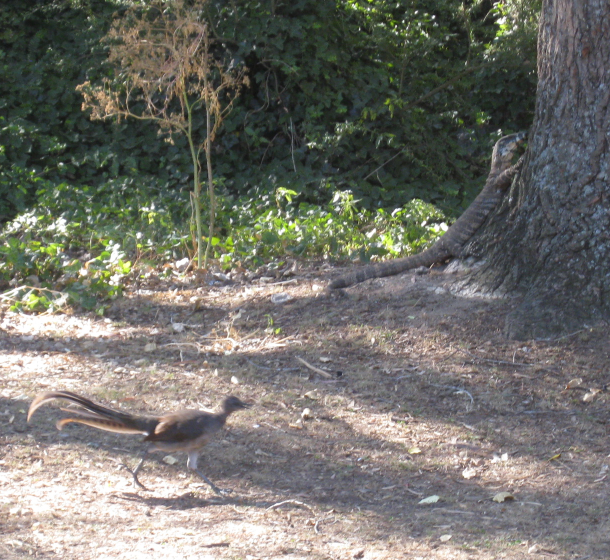
The feathered cast consisted of the usual suspects - magpies, noisy miners, kookaburras - as well as some standouts: a Gang Gang Cockatoo, Australian King Parrots, a pair of masked lapwings, a very tame satin bowerbird, and a few superb lyrebirds with their extraordinary plumes.

This female satin bowerbird made friends with us as we drank an afternoon beer.

This Gang Gang cockatoo was really old and fat - a campground local no doubt.

Top: A male Australian King Parrot plays in the trees with his mate. Bottom: 2 female king parrots look for good things to eat in the mud.

This superb lyrebird is dangerously close to a goanna - who was dangerously close to our tent! Don't worry, goannas aren't dangerous to humans... but they do have bad eyesight and will try to climb up you. They also won't eat an adult lyrebird - but they do steal lyrebird eggs.

Pair of masked lapwings - quite far from a water source.

All in all it was a very enjoyable trip, and Wombeyan Caves turned out to be a great spot for summer birding!